
Introduction to Pharmacokinetics
Pharmacokinetics is a fundamental discipline in pharmaceutical science that investigates how therapeutic compounds behave within the body over time. It examines the processes responsible for absorption, distribution, metabolism and elimination, commonly described by the acronym ADME.
Understanding pharmacokinetic properties is essential for evaluating compound exposure, determining appropriate administration strategies and predicting how pharmaceutical substances interact with biological systems. These investigations contribute to several stages of pharmaceutical development, from early compound characterization to clinical evaluation.
Pharmacokinetic research combines experimental measurements, mathematical modeling and analytical techniques to characterize compound concentrations in biological fluids and tissues. By examining how exposure changes over time, researchers can investigate the relationship between administration, systemic availability and elimination processes.
Fundamental Principles of Pharmacokinetics

Pharmacokinetics provides a quantitative framework for describing the movement of pharmaceutical compounds through biological systems. Following administration, a substance undergoes multiple processes that determine its concentration, distribution and persistence within the body.
These processes are influenced by physicochemical characteristics, formulation properties, administration routes and individual physiological factors.
Absorption
Absorption describes the movement of a pharmaceutical compound from its administration site into systemic circulation. The extent and rate of absorption depend on several factors, including molecular size, lipid solubility, ionization, formulation characteristics and biological membrane permeability.
Different administration routes produce different absorption profiles. Oral administration involves gastrointestinal absorption, whereas intravenous administration introduces the compound directly into systemic circulation.
Other routes include intramuscular, subcutaneous, inhalational, transdermal and sublingual administration.
Distribution
Distribution refers to the reversible transfer of a pharmaceutical compound from the bloodstream into tissues and biological compartments.
This process depends on blood flow, membrane permeability, tissue composition, plasma protein binding and the physicochemical properties of the substance.
The apparent volume of distribution (Vd) describes the relationship between the total amount of a compound in the body and its measured plasma concentration.
Metabolism
Metabolism involves enzymatic transformations that modify the chemical structure of pharmaceutical compounds.
The liver is a major site of metabolism, although these reactions can also occur in the intestine, kidneys, lungs and other tissues.
Metabolic processes are commonly classified into Phase I and Phase II reactions.
Phase I reactions include oxidation, reduction and hydrolysis. Phase II reactions involve conjugation with endogenous molecules, which can increase compound polarity and facilitate elimination.

Excretion and Elimination
Excretion describes the removal of pharmaceutical compounds and their metabolites from the body. The kidneys represent a major elimination pathway through glomerular filtration, tubular secretion and tubular reabsorption.
Other elimination routes include biliary excretion, fecal elimination and pulmonary excretion for volatile substances.
Elimination is an important determinant of systemic exposure and the duration of pharmacological activity.
Pharmacokinetic Parameters and Mathematical Models

Pharmacokinetic parameters provide quantitative information about compound exposure and disposition. Their determination helps researchers characterize the behavior of pharmaceutical substances and compare different formulations or administration strategies.
Maximum Plasma Concentration (Cmax)
Cmax represents the highest measured plasma concentration following administration. This parameter provides information about peak systemic exposure and is commonly used in pharmacokinetic and bioequivalence investigations.
Time to Maximum Concentration (Tmax)
Tmax represents the time required to reach Cmax. It provides information about the rate of absorption and can be influenced by formulation properties and administration conditions.
Area Under the Curve (AUC)
The area under the plasma concentration-time curve represents total systemic exposure over a defined period.
AUC is an important parameter for evaluating bioavailability, comparing pharmaceutical formulations and investigating pharmacokinetic interactions.
Elimination Half-Life
The elimination half-life (t1/2) represents the time required for plasma concentration to decrease by approximately 50% during the terminal elimination phase, under appropriate kinetic conditions.
It is influenced by systemic clearance and apparent volume of distribution.
For a substance following first-order elimination:
t1/2 = 0.693 × Vd / CL
Where Vd represents the apparent volume of distribution and CL represents systemic clearance.
Clearance
Clearance describes the volume of plasma from which a compound is completely removed per unit of time.
It is an important parameter for understanding elimination and estimating maintenance administration requirements.
Total systemic clearance may involve renal, hepatic and other elimination pathways.
Bioavailability and Bioequivalence
Bioavailability describes the rate and extent to which an active pharmaceutical ingredient becomes available in systemic circulation.
Absolute bioavailability compares systemic exposure following extravascular administration with exposure following intravenous administration.
Relative bioavailability compares the systemic availability of different formulations or administration conditions.
Bioequivalence studies investigate whether two pharmaceutical products demonstrate sufficiently comparable rates and extents of absorption under defined experimental conditions.
These investigations are particularly important for evaluating generic pharmaceutical formulations and supporting product development.
Important assessment parameters generally include:
Maximum plasma concentration (Cmax).
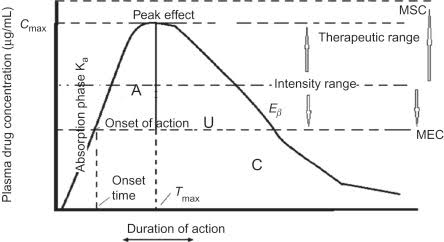
Area under the concentration-time curve (AUC).
Time to maximum concentration (Tmax), when relevant.
Variability between study participants.
Appropriate statistical comparison of pharmacokinetic measurements.
Factors Influencing Pharmacokinetic Variability
Pharmacokinetic behavior can differ between individuals because of physiological, genetic, environmental and clinical factors.
Understanding these differences is important for interpreting experimental results and evaluating variability in therapeutic responses.
Physiological Factors
Age, body composition, organ function, blood flow and gastrointestinal physiology can influence absorption, distribution and elimination.
Changes in hepatic or renal function may modify metabolic capacity, clearance and systemic exposure.
Genetic Factors
Genetic polymorphisms affecting metabolic enzymes and transport proteins can contribute to interindividual pharmacokinetic differences.
Variations in cytochrome P450 enzymes, for example, may influence the metabolic capacity of individuals for specific pharmaceutical compounds.
Pharmaceutical Interactions
Interactions between pharmaceutical substances may alter pharmacokinetic processes by modifying enzyme activity, transporter function or absorption conditions.
Enzyme inhibition can reduce the metabolism of a substrate compound, potentially increasing its systemic exposure.
Conversely, enzyme induction may accelerate metabolism and reduce exposure under certain conditions.
Environmental and Lifestyle Factors
Diet, smoking, alcohol consumption and environmental exposures can influence metabolic enzyme activity and other physiological processes.
These factors may contribute to differences in pharmacokinetic profiles and should be considered when interpreting compound exposure data.
Experimental Methods in Pharmacokinetic Research
Pharmacokinetic investigations require reliable analytical methods capable of measuring pharmaceutical compounds and their metabolites in biological matrices.
Plasma, serum, urine and tissue samples are commonly used depending on the objectives of the investigation.
Liquid Chromatography-Mass Spectrometry
Liquid chromatography coupled with tandem mass spectrometry (LC-MS/MS) is widely used for quantitative pharmaceutical analysis.
It combines chromatographic separation with mass-based detection, allowing sensitive and selective measurement of pharmaceutical compounds.
This technique is particularly useful when analyzing low concentrations of substances and metabolites in complex biological samples.
High-Performance Liquid Chromatography
High-performance liquid chromatography (HPLC) separates chemical compounds according to their interactions with stationary and mobile phases.
Depending on the analytical configuration, detection may involve ultraviolet absorbance, fluorescence or mass spectrometry.
HPLC is used for compound quantification, metabolite analysis and pharmaceutical characterization.
Gas Chromatography-Mass Spectrometry
Gas chromatography-mass spectrometry (GC-MS) is suitable for analyzing volatile and thermally stable compounds or substances that can be converted into appropriate derivatives.
It is particularly useful in selected metabolic and pharmaceutical investigations.

Biological Sample Preparation
Biological samples frequently require preparation before instrumental analysis.
Common procedures include protein precipitation, liquid-liquid extraction and solid-phase extraction.
Appropriate sample preparation improves analytical selectivity and reduces matrix-related interference.
Metabolic Pathways and Enzymatic Processes
Metabolism plays a central role in determining the duration and intensity of systemic exposure.
The cytochrome P450 enzyme family is particularly important because its members participate in the metabolism of numerous pharmaceutical compounds.
Phase I Metabolism
Phase I reactions introduce or expose functional groups through oxidation, reduction and hydrolysis.
Cytochrome P450 enzymes catalyze many oxidative transformations and contribute to the metabolic clearance of numerous pharmaceutical substances.
Phase II Metabolism
Phase II reactions involve conjugation with molecules such as glucuronic acid, sulfate or glutathione.
These reactions frequently increase compound hydrophilicity and facilitate elimination.
Metabolite Identification
Metabolite identification investigates the chemical structures of products generated during metabolism.
Analytical techniques such as LC-MS/MS and high-resolution mass spectrometry can help characterize metabolic pathways and identify potentially relevant metabolites.
Understanding metabolite formation is important for evaluating biological activity, metabolic stability and potential safety concerns.
Pharmacokinetic Modeling and Simulation
Pharmacokinetic modeling uses mathematical approaches to describe changes in compound concentrations over time.
These models support the interpretation of experimental observations and help predict pharmaceutical behavior under different administration conditions.
Compartmental Models
Compartmental models represent the body as one or more interconnected theoretical compartments.
One-compartment models assume relatively rapid distribution within a single homogeneous compartment, whereas multicompartment models describe more complex distribution and elimination behavior.
Noncompartmental Analysis
Noncompartmental analysis estimates pharmacokinetic parameters directly from concentration-time data without requiring a specific compartmental structure.
It is commonly used to calculate AUC, clearance and terminal elimination half-life.
Population Pharmacokinetics
Population pharmacokinetics investigates compound disposition across groups of individuals.
It evaluates interindividual variability and identifies factors that may explain differences in systemic exposure.
Physiologically Based Pharmacokinetic Modeling
Physiologically based pharmacokinetic (PBPK) modeling combines physiological information, anatomical characteristics and compound-specific properties to simulate distribution and elimination across biological tissues.
These models can support investigations of pharmaceutical interactions, special populations and alternative administration conditions.
Pharmacokinetics in Preclinical and Clinical Development
Pharmacokinetic characterization is integrated throughout pharmaceutical development.
During preclinical research, investigators examine absorption, distribution, metabolism and elimination in appropriate experimental models.
These studies help characterize systemic exposure, identify relevant metabolic pathways and support the selection of promising compounds for further investigation.
During clinical development, pharmacokinetic studies evaluate compound concentrations in human participants and investigate relationships between exposure, administration and biological responses.
The information obtained contributes to formulation assessment, administration strategy optimization and the evaluation of potential pharmaceutical interactions.
Pharmacokinetic and Pharmacodynamic Integration
Pharmacokinetics and pharmacodynamics are complementary disciplines.
Pharmacokinetics describes what the body does to a pharmaceutical compound, while pharmacodynamics investigates what the compound does to the body.
Their integration provides a framework for examining relationships between systemic exposure and therapeutic or biological effects.
Pharmacokinetic-pharmacodynamic (PK-PD) models can help characterize concentration-effect relationships, identify relevant exposure thresholds and investigate the duration of pharmacological responses.
This approach supports rational pharmaceutical development and contributes to the scientific evaluation of administration strategies.
Emerging Trends in Pharmacokinetic Research
Advances in analytical instrumentation, computational modeling and biomedical technologies are transforming pharmacokinetic investigations.
Several emerging approaches are expanding the possibilities for understanding compound disposition and predicting pharmaceutical behavior.
Important research directions include:
Artificial intelligence-assisted pharmacokinetic prediction.
Advanced PBPK modeling and simulation.
Integration of pharmacogenomic information.
Microphysiological systems and organ-on-chip models.
Improved bioanalytical technologies.
Personalized pharmacokinetic assessment.
Data-driven analysis of compound exposure and variability.
The integration of these approaches with experimental research may improve the characterization of pharmaceutical behavior and support more efficient development strategies.
Conclusion
Pharmacokinetics is an essential component of pharmaceutical science, providing a systematic understanding of absorption, distribution, metabolism and elimination.
Through quantitative analysis, analytical chemistry, enzymatic investigations and mathematical modeling, researchers can characterize systemic exposure and investigate the factors influencing the behavior of pharmaceutical compounds.
The integration of pharmacokinetic and pharmacodynamic information strengthens the scientific basis of therapeutic development and supports the evaluation of candidate compounds throughout preclinical and clinical research.
As analytical technologies and predictive models continue to advance, pharmacokinetic research will remain central to the development of effective, reliable and scientifically characterized pharmaceutical products.